How to Choose TV Mount for Your Space
- Mario Menendez

- May 16
- 6 min read
A TV that looks perfect in the box can feel completely wrong once it is on the wall. Too high, too far from the seating area, or stuck at an awkward angle, and the whole room feels off. If you are figuring out how to choose TV mount hardware for your home or business, the right decision comes down to more than just screen size.
A good mount should match your TV, your wall, and the way you actually use the room. It also needs to support the weight safely, give you the viewing angle you want, and keep the setup looking clean. That is where many people get tripped up. A mount can be technically compatible and still be a poor fit for your space.
Start with how the TV will be used
Before you compare mount styles, think about where you will watch from most often. A TV in a bedroom usually needs a different setup than a TV in a living room, conference room, waiting area, or patio-adjacent indoor space. If you mostly watch from one fixed spot, a low-profile mount may be the best choice. If people watch from a couch, kitchen, or side chair, more movement can make a big difference.
This is why how to choose TV mount options is really about function first. The mount should support the way the room works every day, not just hold the TV on the wall.
Fixed mounts
A fixed mount keeps the TV close to the wall and does not move once installed. This is the cleanest look, and for many homeowners it is the most appealing visually. It works well in rooms where the TV will be mounted at eye level and viewed straight on.
The trade-off is flexibility. If the TV ends up a little too high, or glare changes during the day, you cannot adjust much after installation. Access behind the screen can also be tighter.
Tilting mounts
A tilting mount allows the TV to angle slightly downward or upward. This is often the smart choice when the TV needs to be mounted above a fireplace, above a dresser, or higher on the wall in a bedroom or office.
Tilt helps with both comfort and glare, but it still keeps the screen relatively close to the wall. If you want a clean look without giving up all adjustability, this is usually a strong middle ground.
Full-motion mounts
A full-motion mount extends, swivels, and tilts. This gives you the most flexibility and works well in corner installations, open-concept rooms, and spaces where viewing positions vary.
It also places more demand on the wall and the installation itself. These mounts are often heavier, and the movement means secure anchoring matters even more. For large TVs or tricky wall surfaces, professional installation is usually the safer call.
Check TV compatibility the right way
Many people assume a mount is chosen by screen size alone. That is only part of it. You also need to check the TV's weight and VESA pattern, which is the spacing of the mounting holes on the back of the TV.
Most mounts list a supported size range, a maximum weight, and compatible VESA measurements. All three need to line up. If your TV falls within the size range but is heavier than the mount allows, that mount is not a match. If the VESA pattern does not fit, it will not install correctly.
It is also worth thinking ahead. If you plan to upgrade to a larger screen soon, that can affect whether the mount you buy now still makes sense later.
Your wall matters more than you think
The wall is just as important as the TV. Drywall alone is not enough for most TV installations. In many cases, the mount needs to be secured into wood studs, masonry, or another structurally sound backing.
That is why choosing a mount without considering the wall can lead to expensive mistakes. Concrete, brick, metal studs, plaster, and standard wood-frame walls all require different hardware and techniques. Some walls also make cable concealment easier than others.
Wood stud walls
These are common and usually straightforward when the stud locations line up with your preferred TV placement. The key is making sure the mount hits the studs correctly and the bracket is leveled precisely.
Concrete or brick walls
These can provide strong support, but they require masonry anchors and the right tools. Installation is less forgiving, and placement needs to be accurate the first time.
Metal studs or specialty walls
These situations often need added planning or specialized anchors. The wrong hardware can compromise stability, especially with larger TVs or full-motion mounts.
If you are unsure what is behind the drywall, do not guess. That is one of the main reasons homeowners call a professional after a DIY attempt starts going sideways.
Choose based on placement, not just wall space
A big blank wall does not automatically mean it is the best location. The best placement depends on eye level, furniture layout, glare from windows, nearby outlets, and how visible cords will be once everything is connected.
For most living rooms, the center of the screen should sit close to seated eye level. In bedrooms, the height may be a little higher depending on the bed and viewing angle. In commercial spaces, placement often needs to balance visibility with foot traffic and room design.
If you are mounting above a fireplace, be especially careful. It can look great, but it is not always the most comfortable viewing height. Heat exposure is another factor. A tilting mount can help, but only if the location is reasonable to begin with.
Don’t overlook cable management
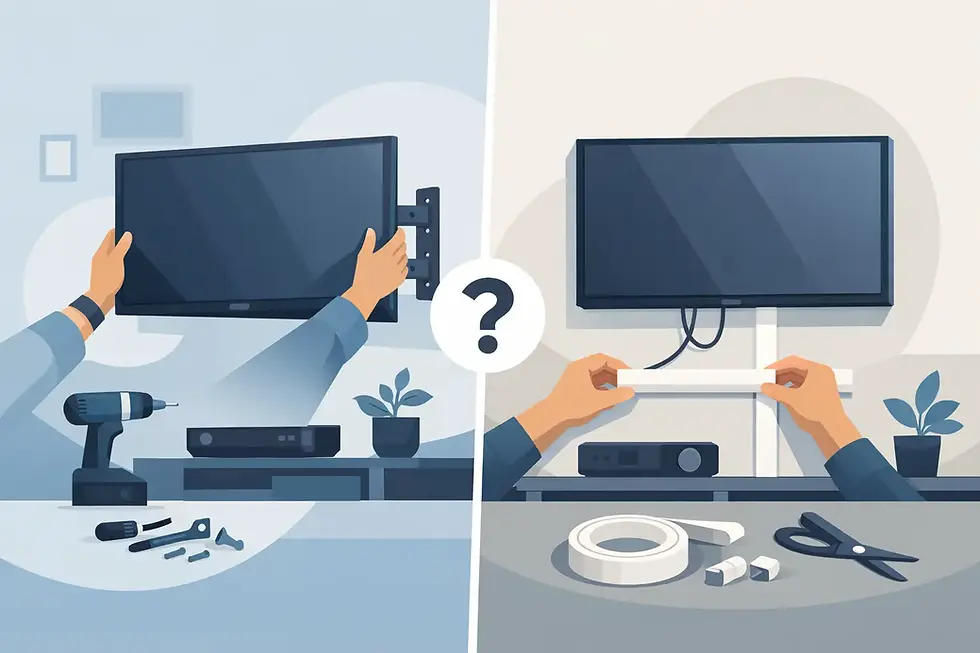
A TV mount can be perfectly secure and still leave the room looking unfinished if the cables hang down the wall. For many customers, the clean setup is just as important as the mount itself.
There are a few ways to handle this. External cord covers are simple and cost-effective. In-wall concealment gives the cleanest look, but it needs to be done properly and in line with local code considerations. If you have a soundbar, gaming console, streaming box, or business display equipment, those components should be part of the plan from the start.
This is another place where the mount style matters. A full-motion mount may need more slack and better cable routing than a fixed mount. If that is not planned well, cords can become visible or strained when the TV moves.
When a cheaper mount is not the better value
It is tempting to buy the least expensive option online and move on. Sometimes that works fine for a small TV on a simple wall with a fixed viewing angle. But low-cost mounts can come with lighter materials, less precise hardware, and installation instructions that leave too much room for error.
The bigger the TV, the more important build quality becomes. This is especially true for full-motion mounts, high-traffic areas, and commercial settings where durability matters. A good mount should feel solid, operate smoothly, and stay secure over time.
The same goes for installation. Saving money on the mount does not help if the TV ends up crooked, poorly supported, or awkwardly placed. A clean, secure result depends on both the product and the workmanship.
When professional installation makes sense
Some TV setups are simple. Others involve heavy screens, difficult wall types, hidden wiring, soundbar mounting, or multiple TVs in one property. That is when professional service becomes less of a luxury and more of a practical decision.
A trained installer can help confirm the right mount type, locate studs accurately, place the TV at the right height, and make the final setup look finished instead of improvised. For busy homeowners, renters who want to avoid wall damage, and property managers trying to get units ready quickly, that time savings matters.
Pronto Handyman handles TV mounting with that same focus - secure installation, precise placement, and a clean result that fits the room.
How to choose TV mount without second-guessing it
If you want a simple way to decide, narrow it down to five questions. What size and weight is your TV? What kind of wall are you mounting to? Do you need fixed, tilt, or full motion? Where will people watch from? How important is hidden cable management?
Those answers usually point to the right option quickly. The best mount is not the one with the most features. It is the one that fits your TV safely, works with your wall, and gives you the clean, comfortable setup you want every day.
A well-mounted TV should feel effortless once it is done. If you are still debating between mount types, that usually means the room needs a closer look, not a guess.